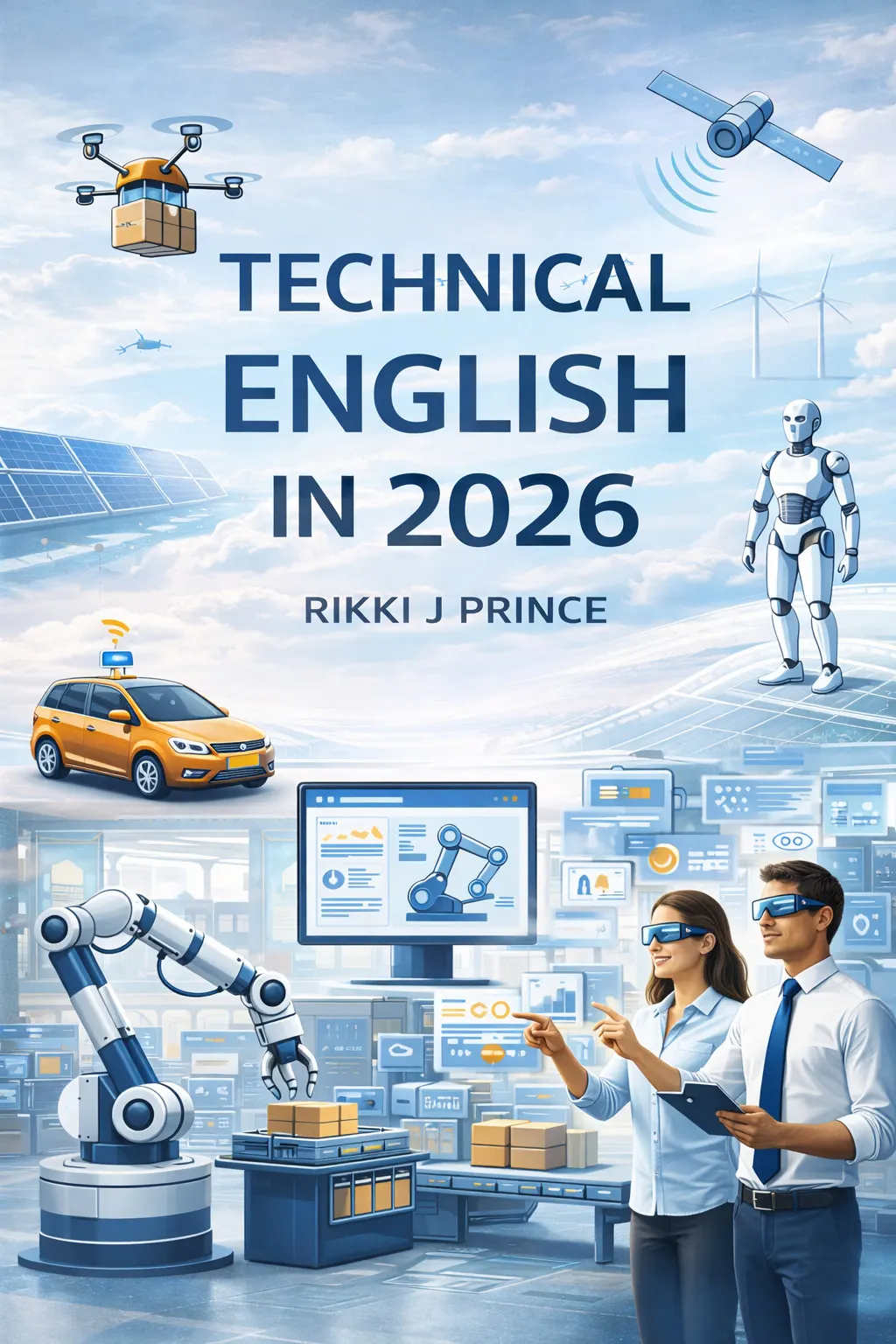
Technical English in 2026
Rikki J Prince
What this book is
Technical English in 2026 is designed to help learners develop confident, accurate, and practical English for modern technical and professional environments.
Rather than teaching isolated vocabulary lists, the book presents technical language in context — the way it is actually used by engineers, technicians, project managers, and technical specialists working with contemporary systems.
The technologies explored reflect today’s real workplaces:
automation, robotics, industrial networks, artificial intelligence, logistics, and energy systems.
Who this book is for
This book is suitable for learners who:
- Already have a solid general command of English (CEFR B2 or above)
- Work — or plan to work — in technical, industrial, or engineering-related fields
- Need to read, explain, discuss, and make decisions in professional English
- Want language that reflects how industry actually functions in the mid-2020s
What the book covers
The book is structured into three main parts, moving from physical systems to digital intelligence and finally to operations and management.
Part I — Core Industrial Technologies
Industrial production, robotics, control systems, sensors, materials, energy, and predictive maintenance.
Part II — Digital & Intelligent Industry
Industrial networks, cloud systems, cybersecurity, AI and machine learning, digital twins, additive manufacturing, and sustainability.
Part III — Systems, Operations & Management
Logistics, supply chains, quality systems, regulation, project management, and future workforce trends.
Together, these sections form a coherent technical landscape, rather than a disconnected set of topics.
How each chapter works
Every chapter follows the same clear, repeatable structure:
1. A short technical scenario
A realistic workplace situation introduces key concepts and terminology in a natural, accessible way.
2. A visual systems task
Diagrams and system illustrations help you identify components, understand processes, and connect language to real technology.
3. Precision vocabulary exercises
You practice technical terms through definitions, functions, and typical professional usage — not memorisation.
4. A communication task
You apply what you’ve learned by explaining a system, discussing a problem, or making a technical decision, just as you would in a real job.
How this book fits into the wider project
Technical English in 2026 is part of a broader approach to language learning that treats English not as an abstract skill, but as a tool for thinking, coordination, and decision-making in complex environments.
It connects naturally with:
- RJ Communication Lab — for guided training and professional application
- Hybrid English 5.0 — for cognitive and narrative language development